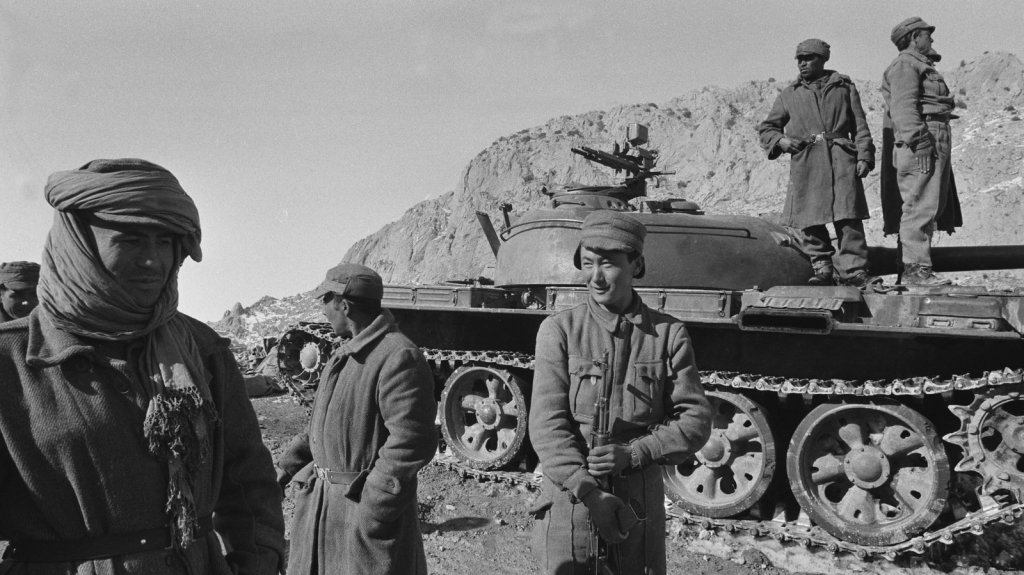
As the diplomat Zbigniew Brzezinski once warned, ‘Afghanistan became the last battle of the Cold War—but its first casualty was humanity.’ The Soviet-Afghan War (1979–1989) is often seen as a proxy clash between superpowers, yet its conflict between the United States and Soviet Union was a catalyst for devastation that poisoned relations between Afghanistan and Pakistan.
Superpower Involvement
The Soviet Union’s direct military intervention in Afghanistan in 1979 marked a pivotal moment in the Cold Was, as both superpowers sought to expand their spheres of influence. According to the U.S. State Department, the USSR deployed over 100,000 troops to help the Marxist PDPA (People’s Democratic Party of Afghanistan), employing brutal tactics including village destruction and aerial bombardments. In response, the US launched Operation Cyclone, which became the most expensive covert action in history, funneling more than $2 billion in weapons and support to Mujahideen rebels. While the USSR aimed to secure a buffer zone against the spread of from Iran, the U.S. exploited the conflict to drain Soviet resources. This superpower rivalry transformed Afghanistan into a laboratory, where ideological experiments were conducted at the cost of Afghan lives. By 1989, an estimated 6 million Afghans had fled their homes, with half seeking refuge in Pakistan. This mass exodus not only strained Pakistan’s resources but also caused refugee camps to became breeding grounds for extremism, This irreparably damaged Afghan-Pakistan relations, as the influx of displaced people strained resources and changed the socio-political landscape of both nations.
Impact on Afghan-Pakistan Relations
The Proxy War ultimately led to a rocky victory for the United States in expanding its sphere of influence, while the Soviet Union’s attempt to protect its socialist views backfired catastrophically. According to CIA estimates, the USSR spent approximately 15 billion rubles on the war through 1986, with annual costs reaching about 2.5 percent of their military budget. This financial drain, coupled with the loss of over 15,000 Soviet troops, turned Afghanistan into what Mikhail Gorbachev called a “bleeding wound” for the Soviet Union. While the U.S. initially celebrated the withdrawal in 1989 as a victory, its subsequent retreat from the region had major consequences. The struggle between the two superpowers enabled the rise of extremist factions, including the Taliban and Al-Qaeda, which would later threaten global security. This shortsighted approach to the influence of the cold war neglected the long-term stability of Afghanistan and its neighbors, particularly Pakistan. Therefore, while the U.S. may have prevailed in the immediate Cold War context, both superpowers’ actions during the war contributed to a legacy of regional instability and mutual distrust between Afghanistan and Pakistan.
Regional Instability
The Soviet-Afghan War’s impact on the region, particularly Afghanistan and Pakistan, was profound and enduring. The refugee crisis not only strained Pakistan’s resources but also provided a perfect ground for radicalization. Pakistan’s Inter-Services Intelligence (ISI) exploited this situation, training Mujahideen factions in refugee camps, which later evolved into more extreme groups like the Taliban. Pakistan viewed this proxy warfare as a means to gain “strategic depth” against India, using Afghanistan as a buffer zone. However, this strategy backfired, fueling Afghan resentment over perceived Pakistani interference and increasing tensions over the Durand Line border. The Atlantic Council notes that Pakistan’s support for groups like the Haqqani Network has led to blowback, with terrorist attacks within Pakistan itself. Furthermore, the refugee crisis has created a persistent humanitarian challenge, with the United Nations reporting that as of 2025, 22.9 million Afghans still require aid. The recent mass deportation of 800,000+ Afghan refugees by Pakistan in 2023 has only deepened the mutual distrust between the two nations. This complex web of conflicts not only impacts Afghan-Pakistan relations but has also drawn in other regional powers like India, creating more cyclical tensions in south Asia.
Superpower Rivalry
The Soviet-Afghan War profoundly deteriorated relations between the superpowers, effectively reigniting Cold War tensions. According to the U.S. State Department’s Office of the Historian, President Carter’s response to the Soviet invasion was severe. He imposed economic sanctions and trade embargoes against the Soviet Union, called for a boycott of the 1980 Moscow Olympics, and increased aid to Afghan insurgents. U.S. support for the mujahideen reached up to $700 million per year under President Reagan, totaling approximately $2 billion. Tensions only when President Carter, in his Address to the Nation, stated that the Soviet action threatened “the stable, strategic, and peaceful balance of the entire world”. In response to U.S. aggression, the USSR carpet-bombed cities like Kandahar, whose population plummeted from 250,000 to 25,000, and planted millions of landmines across Afghanistan. The impact of these actions is evident in the persistent instability of Afghan Pakistan relations underscoring the need for a better understanding of how global power struggles can impact local relationships.
In conclusion, the refugee crisis caused by the Soviet-Afghan War profoundly impacted Afghan-Pakistan relations. Although critics argue that relations were already strained due to historical border disputes and cultural difference, it is clear to see that the superpower rivalry and resulting refugee crisis had devastating impacts, straining Pakistan’s resources and radicalizing refugee camps. This assembly must recognize a hard truth: superpower interventions prioritized influence over stability, leaving Afghanistan dependent on Pakistan and Pakistan burdened by blowback. This negligence has devastating impacts on distrust, extremism, and regional distability that endures in 2025.
Works Cited
Al Jazeera. “Soviet Veteran Recalls Afghan War – 24 Dec 09.” Www.youtube.com, 24 Dec. 2009, http://www.youtube.com/watch?v=ejUsQaQMH0k. Accessed 3 Apr. 2023.
Basir, Sparghai. “Pakistan’s Expulsion of Afghan Refugees Echoes a 40-Year History.” New Lines Magazine, 14 Nov. 2023, newlinesmag.com/first-person/pakistans-expulsion-of-afghan-refugees-echoes-a-40-year-history/.
Bhutta, Z. A. “Children of War: The Real Casualties of the Afghan Conflict.” BMJ, vol. 324, no. 7333, Feb. 2002, pp. 349–52, https://doi.org/10.1136/bmj.324.7333.349.
Britannica. “Soviet Invasion of Afghanistan.” Encyclopædia Britannica, 17 Oct. 2018, http://www.britannica.com/event/Soviet-invasion-of-Afghanistan. Accessed 22 Mar. 2025.
Butt, Khalid, and Azhar Siddqi. “Pakistan-Afghanistan Relations from 1978 to 2001: An Analysis.” South Asian Studies a Research Journal of South Asian Studies, vol. 31, no. 2, 2016, pp. 723–44, pu.edu.pk/images/journal/csas/PDF/22_31_2_16.pdf.
Cheema, Pervaiz Iqbal. “The Afghanistan Crisis and Pakistan’s Security Dilemma.” Asian Survey, vol. 23, no. 3, 1983, pp. 227–43, https://doi.org/10.2307/2644271.
CIA. The Costs of Soviet Involvement in Afghanistan. 2000, http://www.cia.gov/readingroom/docs/DOC_0000499320.pdf. Accessed 25 Mar. 2025.
https://www.facebook.com/saddam.samo. “Negative Impacts of Soviet-Afghan War on Pakistan | the Authentic Post.” The Authentic Post, 19 July 2020, theauthenticpost.com/negative-impacts-of-soviet-afghan-war-on-pakistan/. Accessed 25 Mar. 2025.
National Geographic. Afghan Migration after the Soviet Invasion . media.nationalgeographic.org/assets/file/afghan_MIG.pdf. Accessed 22 Mar. 2025.
Office of the Historian. “The Soviet Invasion of Afghanistan and the U.S. Response, 1978–1980.” State.gov, 2024, history.state.gov/milestones/1977-1980/soviet-invasion-afghanistan.
Pick, Hella. “From the Archive, 19 June 1980: Soviets Find Afghan Rebels No Pushover.” The Guardian, The Guardian, 19 June 2013, http://www.theguardian.com/theguardian/2013/jun/19/afghanistan-russia-heavy-cost. Accessed 22 Mar. 2025.
RadioFreeEurope. “Victims of Soviet-Afghan War Live Forgotten in Pakistan Refugee Camp.” RadioFreeEurope/RadioLiberty, 14 Feb. 2014, http://www.rferl.org/a/pakistan-soviet-afghan-refugees/25264055.html.
Riedel, Bruce. “Pakistan’s Role in the Afghanistan War’s Outcome.” Brookings, 20 May 2010, http://www.brookings.edu/articles/pakistans-role-in-the-afghanistan-wars-outcome/.
Savranskaya, Svetlana. “Afghanistan: Lessons from the Last War.” Nsarchive2.Gwu.edu, 9 Oct. 2001, nsarchive2.gwu.edu/NSAEBB/NSAEBB57/soviet.html.
Schmemann, Serge, and Special To the New York Times. “GORBACHEV SAYS U.S. ARMS NOTE IS NOT ADEQUATE (Published 1986).” The New York Times, 26 Feb. 1986, http://www.nytimes.com/1986/02/26/world/gorbachev-says-us-arms-note-is-not-adequate.html.
Sheikh, Ali T. “SOVIET and WESTERN MEDIA COVERAGE of the AFGHAN CONFLICT.” Strategic Studies, vol. 13, no. 3, 1990, pp. 35–63, http://www.jstor.org/stable/45182014. Accessed 22 Mar. 2025.
The Diplomat. “How the Soviet Invasion of Afghanistan Strengthened Pakistan’s Military Deep State.” Thediplomat.com, thediplomat.com/2024/01/how-the-soviet-invasion-of-afghanistan-strengthened-pakistans-military-deep-state/.
Times, Bernard Gwertzman; Special to The New York. “U.S. REPORTS SOVIET FLYING MANY TROOPS to AFGHAN CONFLICT.” The New York Times, 27 Dec. 1979, http://www.nytimes.com/1979/12/27/archives/us-reports-soviet-flying-many-troops-to-afghan-conflict-world.html. Accessed 22 Mar. 2025.
Weinbaum, Marvin G. “Pakistan and Afghanistan: The Strategic Relationship.” Asian Survey, vol. 31, no. 6, June 1991, pp. 496–511, https://doi.org/10.2307/2645079.
 Claire Voyant
Leave a comment