• The European Union: A Bureaucratic Ballet of Brexit and Borders

    Caitlyn Rodrigues

    Prologue: The creation of the European Nation

    The European Union’s performance on the international stage has entered a new act, with Brexit and immigration taking center stage in this complex political ballet. As of March 2025, the EU finds itself dancing through a series of challenges. Its beginning can be traced back to the aftermath of World War II, with its formal establishment occurring on November 1, 1993, when the Maastricht Treaty came into force (Gabel, 2019). Driven by a desire for lasting peace and economic growth, the EU was created as a central theatre in a continent devastated by two world wars, with the ultimate goal of fostering economic, social, and political ties among European nations (European Union, 2024).

    Act 1: The Brexit Saga 

    1. A desire to “Take Back Control”: According to Westcott (2020), many British citizens believed that choices that affected their nation were increasingly being decided in Brussels instead of by their own elected representatives.  This sentiment was fueled by a perception that EU regulations limit the UK’s ability to govern itself independently. The Leave campaign capitalized on this narrative with its slogan “Take Back Control,” arguing that leaving the EU would restore its parliamentary power and allow the UK to set its own laws, trade policies, and regulations without interference from the EU. (Riley & Ghilès, 2016)
    2.  Immigration Anxieties: Immigration became a central issue in the Brexit debate, particularly following the EU’s 2004 enlargement, which allowed free movement of workers from Central and Eastern European countries such as Poland, Hungary, and Romania. The influx of migrants into the UK—many of whom took up low-wage jobs—sparked fears about job competition, wage suppression, and pressure on public services like housing, healthcare, and education (Lee, 2016). Politicians like Nigel Farage and the UK Independence Party (UKIP) amplified these fears with provocative campaigns, including controversial posters warning of unchecked migration. 
    3. Regional inequality: Economic disparities set the stage for discontent in many parts of the UK. Former powers, feeling like understudies in the globalization play, saw Brexit as a chance to raise their voice in frustration with a political system they believed had forgotten them. The economic gaps between regions widened after the 2008 financial crisis, with London and the South East taking center stage while other areas were left on the sidelines.

    All these issues pile up in one catastrophic final act, leading to Britain’s final goodbye from the EU.

    Act 2: The Brexit Aftermath

    The dramatic performance that began with the 2016 referendum, reached its climax on January 31, 2020, when the UK officially exited the EU stage (Armstrong, 2025). This pivotal act in the European political theater has had far-reaching consequences, with economists predicting a reduction in the UK’s real per capita income and a decrease in trade and investment (Chu & Kovacevic, 2025) .Five years after the departure, the economic and social impacts remain profound. The UK economy has contracted by an estimated 3.2% of GDP as of 2025, with long-term projections suggesting a 4% annual GDP hit, translating into billions in lost output (Statista, 2018). Trade, once seamless within the EU, now stumbles under the weight of non-tariff barriers, with UK goods exports down by nearly 10% since 2019, while small and medium enterprises bear the brunt of increased costs and regulatory hurdles (Labiak, 2024). Labour shortages, exacerbated by reduced EU migration, have also strained key industries like manufacturing and logistics, further compounding productivity challenges. As a result, public sentiment in today’s world has shifted dramatically; as of early 2025, 55% of Britons regret leaving the EU, with only 30% believing it was the right decision (Statista, 2023). The promises of economic freedom that fueled Brexit have yet to materialize, leaving many to question whether this act in the UK’s political drama was worth its cost. Meanwhile, the EU has had to navigate new trade dynamics without one of its lead performers. This economic situation has also impacted the remaining EU members, adversely effecting Ireland, the Netherlands, and Belgium.  As the curtain rises on 2025, the EU finds itself grasping at straws to maintain unity in geopolitical tensions, improving competitiveness, and grappling with the ongoing support for Ukraine (European Newsroom, 2025). 

    Act 3: The Balancing Act

    In the post-Brexit era, the UK finds itself performing a delicate balancing act on the immigration stage. Despite Brexit’s promise to “take back control” of borders, net migration has not decreased as anticipated. Instead, the UK has witnessed a sharp decline in migration, with more EU citizens leaving than entering the UK (Hayes, 2024) The new immigration system has introduced both opportunities and challenges. On one hand, it has liberalized rules for non-EU migrants, potentially attracting global interest. On the other, it has created new vulnerabilities for EU migrants, who now face more restrictive rules and fewer rights than under free movement. As a result, the UK’s public finances continue to benefit from migrant contributions, with studies showing that EU migrants pay more in taxes than they receive in benefits and services. Certain sectors, particularly those relying on lower-skilled EU workers, are experiencing labor shortages. The academic scene has seen a significant plot change, with EU student applications to UK universities plummeting by 53% due to increased fees and visa requirements (Riley & Ghilès, 2016) .As the curtain rises on 2025, the UK’s immigration drama continues to unfold, with policymakers, employers, and migrants alike adjusting to the new realities.

    Act 4: The Finale

    The European Parliament has undergone a significant transformation, with its total seats reduced from 751 to 705. While 46 of the UK’s former 73 seats remain in reserve for potential future members, 27 seats have been redistributed among 14 member states. (Kaup & Edwards, 2020) France and Spain emerged as the leading beneficiaries, each gaining five additional seats, followed by Italy and the Netherlands with three new seats each. (Members’ Research Service) Additionally, the departure of British MEPs has altered the ideological composition of the European Parliament. Right-leaning groups, particularly those led by British conservatives, have seen their influence diminish. Conversely, the Progressive Alliance of Socialists and Democrats has found itself in a stronger position to form majorities without relying on conservative support. Furthermore, the EU-27’s economic performance has been impacted by Brexit, with real output estimated to be 0.8% lower in the long run under a standard free trade agreement scenario. Ireland faces the most significant economic impact, with a potential 2.5% reduction in output compared to a no-Brexit scenario (Chen et al., 2018).

    Epilogue 

    In conclusion, the Brexit saga has left an incredible mark on the European Union’s grand performance. As the curtain rises on a new era, the EU must navigate the challenges of a post-Brexit world. As in any play, as the puppeteers, the EU must balance its desire for unity with the need to address the diverse concerns of its member states. The drama of Brexit serves as a reminder that even in the most intricate performances, change is inevitable and the ability to adapt is crucial for survival. As the EU continues to evolve, it must ensure that its choreography responsive to the ever-changing rhythm of global politics.

    References

    Armstrong, R. E. (2025, January 31). Five years of Brexit: Is the United Kingdom better off? Euronews; Euronews.com. https://www.euronews.com/my-europe/2025/01/31/five-years-of-brexit-is-the-united-kingdom-better-off

    Chen, J., Ebeke, C., Lin, L., Qu, H., & Siminitz, J. (2018, August 10). The Long-Term Impact of Brexit on the European Union. IMF. https://www.imf.org/en/Blogs/Articles/2018/08/10/blog-the-long-term-impact-of-brexit-on-the-eu

    Chu, B., & Kovacevic, T. (2025, January 31). Five key impacts of Brexit five years on. BBC. https://www.bbc.com/news/articles/cdrynjz1glpo

    European Newsroom. (2025, January 3). Europe’s 2025: Security, competitiveness and political turbulence. European Newsroom. https://europeannewsroom.com/europes-2025-security-competitiveness-and-political-turbulence/

    European Union. (2024). History of the European Union 1945-59. European-Union.europa.eu. https://european-union.europa.eu/principles-countries-history/history-eu/1945-59_en

    Gabel, M. (2019). European Union | Definition, Purpose, History, & Members. In Encyclopedia Britannica. https://www.britannica.com/topic/European-Union

    Hayes, A. (2024, June 29). Brexit Meaning and Impact: The Truth About the U.K. Leaving the EU. Investopedia. https://www.investopedia.com/terms/b/brexit.asp

    Kaup, T., & Edwards, G. (2020, February 21). The EU Institutions Post-Brexit: 2020 Update. FiscalNote. https://fiscalnote.com/blog/the-eu-institutions-post-brexit-2020-update

    Labiak, M. (2024, September 16). Brexit deal impact “worsening”, economists say. Bbc.com; BBC News. https://www.bbc.com/news/articles/cd988p00z1no

    Lee, T. B. (2016, June 22). Brexit: the 7 most important arguments for Britain to leave the EU. Vox; Vox. https://www.vox.com/2016/6/22/11992106/brexit-arguments

    Members Research Service. (2020, January 15). The European Parliament after Brexit. Epthinktank. https://epthinktank.eu/2020/01/15/the-european-parliament-after-brexit/

    Riley, A., & Ghilès, F. (2016). Brexit: Causes and Consequences. Cidob.org. https://www.cidob.org/en/publications/brexit-causes-and-consequences

    Statista. (2018). Effect of Brexit on real GDP 2018-2023 | Statista. Statista; Statista. https://www.statista.com/statistics/567983/effect-of-brexit-on-gdp-in-the-uk/

    Statista. (2023). Brexit opinion poll 2021. Statista. https://www.statista.com/statistics/987347/brexit-opinion-poll/

    Westcott, N. (2020, November 26). Sovereignty and Brexit: Control of What exactly? UK in a Changing Europe. https://ukandeu.ac.uk/sovereignty-and-brexit-control-of-what-exactly/
  • The Oil Odyssey 

    In today’s interconnected world, changes in lifestyle choices significantly influence market consumption patterns which is why the investigation into the impact of the Russo-Ukrainian war and the changing climate conditions on the demand and supply of crude oil compared to olive oil in Europe is essential. It can help further our understanding of the influence of the factors on market production and consumption patterns. Europe was selected because it faces direct implications of the effects of war and climate conditions as both issues ultimately arise from the area. Accordingly, the time period of 5 years (2019-2023) provides sufficient duration to analyze supply and demand on each commodity prior during their respective influences.

    Olive Oil

    Market Analysis

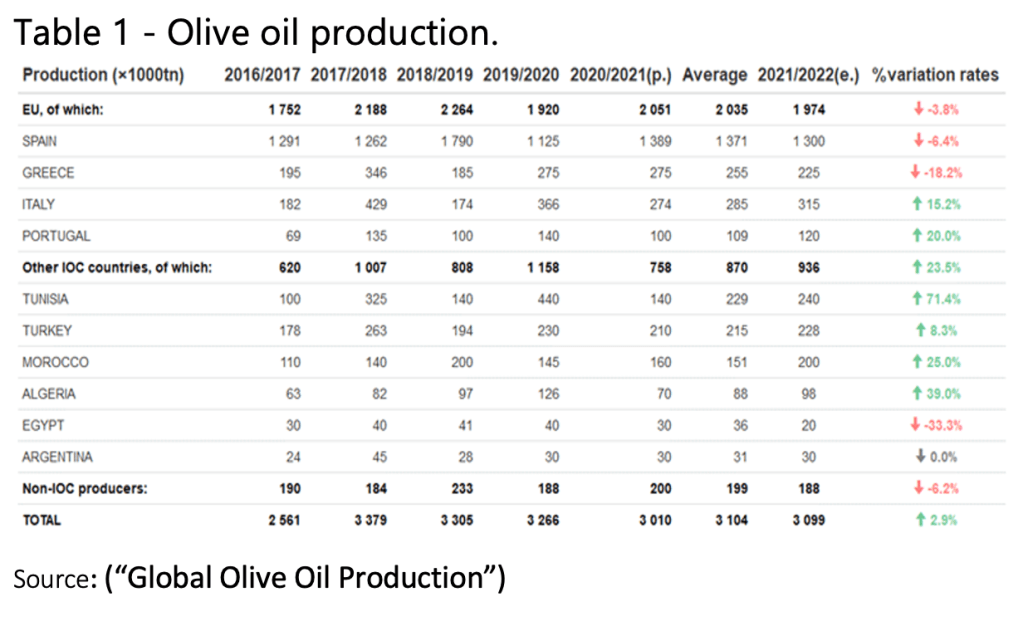
    The market for olive oil is thriving; with Europe dominating global consumption and production. Spain ranks the world’snumber one producer, with Greece and Italy following. In the last 60 years, production has tripled (Rocha et al.)  This rapid increase is due to technological advancements, with techniques such as pulsed electric field methods improving production and quality. However, climate change has caused a notable decline in olive oil production since 2017/2018, dropping from 3,379,000t to 3,099,000t by 2021/2022 (see Table 1).

    The effect of the changing climate conditions

    Climate change is seen in rising temperatures and extreme weather events such as droughts, and heatwaves that disrupt the cultivation of olive trees. This leads to reduced yields and lower oil production. For instance, in 2018, an extreme drought in Spain caused regions to experience 50% losses. Similarly, in 2021, a severe frost in Italy damaged olive groves and resulted in a substantial reduction of output.

    Furthermore, risk analysis done by the Euro-Mediterranean Center on Climate Change in Europe suggested that in the future there will be a “more desertification, and a rise in hot and dry days throughout the year.” (qtd. in OFI), resulting in olive oil production falling below the lowest yield since 2016/17.

    The effect of the Russo-Ukrainian war on the production of olive oil

    Another important factor to consider is the Russo-Ukrainian war. From a social aspect, the displacement of populations, disruption of traditional farming practices, and changes in labor availability have all influenced the social landscape of olive-growing regions centered in Europe. These social disruptions can lead to challenges in maintaining consistent production levels and quality standards.

    The implications on market prices

    The demand for olive oil has always remained high due to its essentiality in the Mediterranean diet. However, in recent years the price has shot up globally with Spain seeing a 112% rise in olive oil prices in 2023.

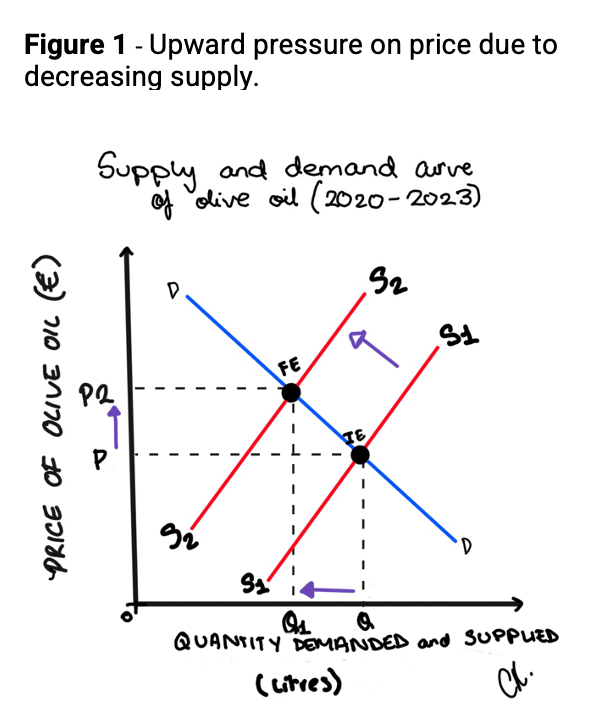
    Although the demand for olive oil is ever soaring, the International Olive Council states that the production of the commodity will be about 3m tones short of global demand. Because of this, high demand then exerts an upward pressure on prices, to reduce the demand of olive oil – as per the law of demand, ceteris paribus, the greater the price the lower the quantity demanded.

    According to CNN, “After a Spanish drought in 2022, prices of olive oil from Europe jumped 80%, according to the EU” (Nadeau). Looking at Figure 1, it is clear to see how the high demand of olive oil has caused an upward pressure in price in hopes of EU oil production being able to cope with the subsequent lower demand.

    Crude Oil

    Market Analysis

    In recent years, European crude oil market instability surged due to geopolitical tensions and climate shifts. Within Europe, Russia and Norway are among the largest crude oil producers with Germany, and the UK following up as the major consumers relying on it for transportation, heating, and industrial purposes

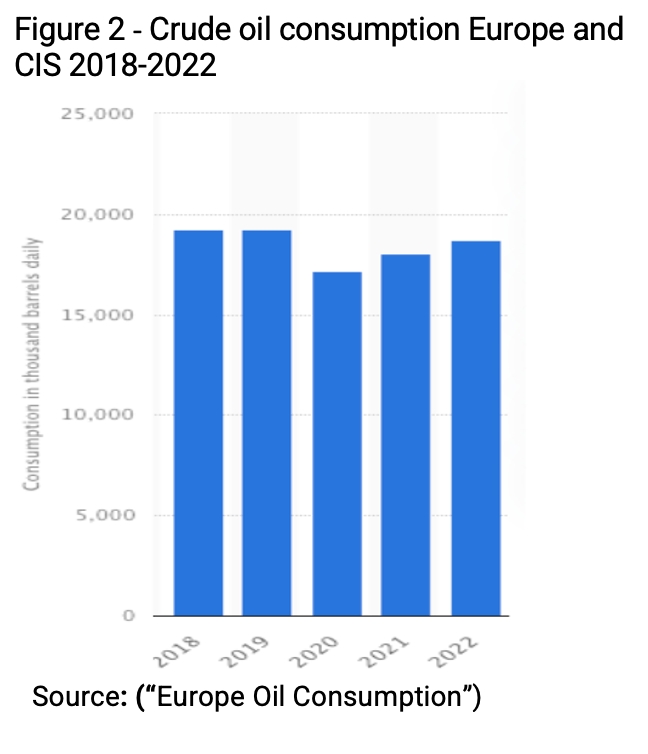
    In 2022, approximately 18.7 million barrels of oil daily were consumed in Europe and the CIS (see Figure 2). Although efforts to reduce carbon emissions have led to a small decline, the majority of the region still relies heavily on the commodity and are dependent on the import from its major exporters.

    The effect of the Russo-Ukrainian war on the production of crude oil:

    The Russo-Ukraine conflict has disrupted its crude oil supply, disrupting critical infrastructure, pipelines, and refineries, essential for the production and transportation. This has caused outages and delays in production. Since the war, the export of Russian natural gasses into Europe has decreased by almost 75%, due to infrastructure disruption. In August 2022, the export company Gazprom reported a significant supply decrease from poor maintenance on the Nord Stream 1 pipeline. (Reuters and Gordeyeva).

    Additionally, the rising geopolitical tensions prompted European countries to impose sanctions on Russia, limiting access to international markets, and hurting the supply of crude oil.

    The effect of the changing climate conditions on the production of crude oil:

    Temperature extremes affect efficiency of production of crude like in Russia when record heat temperatures accelerated the melting of permafrost and damaged 40% of infrastructure in northern regions heavily reliant on oil production (Nichols and Clisby). Furthermore, climate change can also worsen water scarcity where processes require significant amounts of water for extraction and refining.

    The implications on market prices:

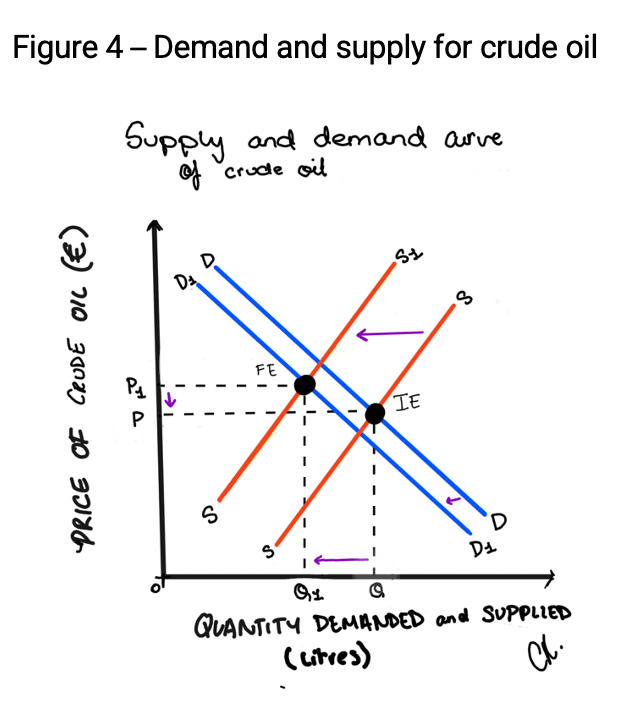
    As supply of crude oil decreases, price mechanism – when the forces of demand and supply determine the prices of commodities – details a change in price. As such, the inability to satisfy the demand for crude oil in the EU, creates an upward pressure on price, causing an increase in equilibrium price for any quantity, meaning that consumers will now place a higher value on crude oil.  Within Europe itself, the prices of Brent crude have risen more than 30% in the last 3 months of 2023 (Duggan). According to Forbes Advisor, “gasoline prices have followed suit and are up 13.6 cents per gallon from a year ago to a national average of $3.80 per gallon” (Adams).

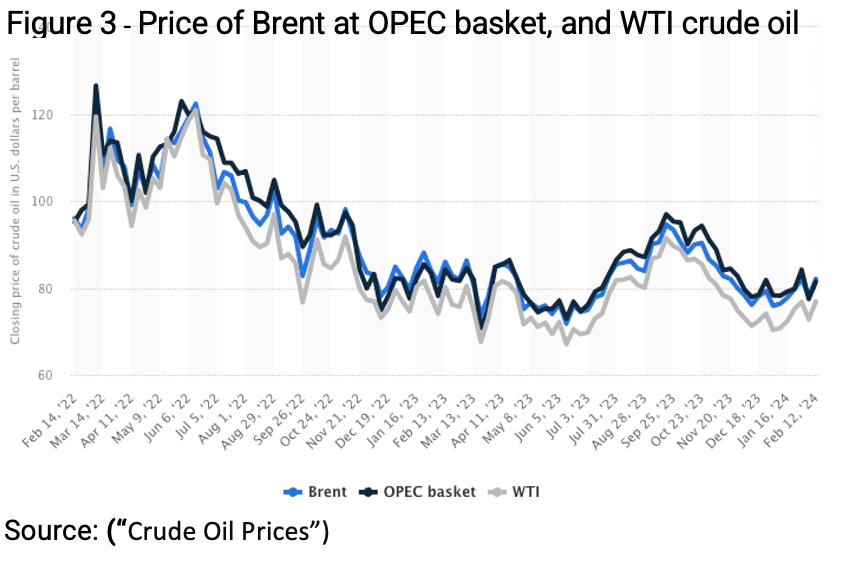
    The demand for crude oil is also decreasing: “The shift to a clean energy economy is picking up pace, with a drop in global oil demand as energy efficiency and other technologies advance,” said IEA Executive Director Fatih Birol (qtd. in IEA). As seen in Figure 3, the price of crude oil has significantly dropped since the original shock in 2022, as the lower demand, especially in Europe, pushes downward pressure on prices. The lower demand could partially offset the price increase caused by the decrease in supply (see Figure 4), helping moderate the extent of the price increase or even lead to a lower equilibrium price compared to what it would have been.

    Comparison

    Despite both experiencing price increases, crude oil and olive oil impact their markets differently based on demand and supply dynamics.

    In terms of demand, Olive oil maintains high demand due to its various uses in the Mediterranean diet, remaining strong despite fluctuations in production. Crude oil demand, although high, has shifted due to cleaner energy transitions. Both oils have similar demand levels, but olive oil’s essentiality in diets sustains its relatively, inelastic demand; as seen in Figure 5, the demand for olive oil is steep.

    However, transitions to green energy may lead to more elastic demand for crude in the long term (see figure 6).  The flatter line indicates the rising elasticity of demand for crude oil as consumers aim for more green practices.

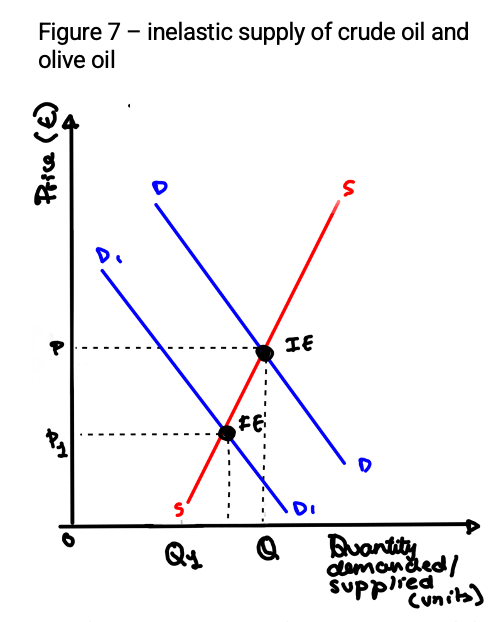
    Both crude and olive oil face supply drops. Olive oil production growth is threatened by climate change, reducing future production due to factors like olive tree maturity time and limited production capacity. Conversely, the Russo-Ukrainian war heavily impacts crude oil production, reducing supply due to infrastructure disruptions and trade restrictions. Crude oil supply is inelastic due to costly extraction processes, restricted through a long time period and slow production speed.

    As seen in Figure 7, as the demand shifts, marginally small shift for olive oil and a big shift in crude oil respectively, the supply is at a constant because both commodities lack production capacity and time to respond the price changes in the market quickly.

    Olive oil prices surged due to inadequate production meeting global demand. Similarly, crude oil prices rose during geopolitical tensions and conflicts. Transitioning to cleaner energy sources may ease some price increases, leading to more moderate rises.

    Conclusion

    In conclusion, over the past five years, the changing climate conditions and the Russo-Ukrainian war have caused significant impacts on both olive oil and crude oil markets in Europe. These influences have highlighted the complex relationships between geopolitical tensions and environmental changes, shaping the identities of regions and their economic relationships. While olive oil production has faced challenges due to climate change, resulting in fluctuations in supply and rising prices driven by high demand, crude oil markets have been disrupted by geopolitical tensions, infrastructure damage and trade restrictions. All these factors have shaped the way demand and supply affect crude oil and olive oil and contribute an ever-evolving economic scene.

    Works Cited

    Brito, et al. “Drought Stress Effects and Olive Tree Acclimation under a Changing Climate.” Plants, vol. 8, no. 7, July 2019, p. 232, https://doi.org/10.3390/plants8070232. Accessed 26 May 2020.

    Butler, Sarah, et al. “Europe’s Olive Oil Supply Running out after Drought – and the Odd Hailstorm.” The Guardian, 28 Sept. 2023, http://www.theguardian.com/world/2023/sep/28/europes-local-olive-oil-supply-runs-almost-dry-after-summer-of-extreme-weather. 

    Europe and CIS: Oil Consumption 2022. Statista, 25 Aug. 2023, http://www.statista.com/statistics/332050/total-oil-daily-consumption-in-europe/#:~:text=In%202022%2C%20approximately%2018.7%20million. Accessed 16 Feb. 2024.

    Finch, Walter. “Olive Oil Crisis Laid Bare: These Are the Devastating Factors behind a Shock 50% Fall in Production of Spain’s ‘Liquid Gold.’” Olive Press News Spain, 13 Jan. 2024, http://www.theolivepress.es/spain-news/2024/01/13/these-are-the-devastating-factors-behind-spains-shock-50-fall-in-olive-oil-output-over-the-last-two-years/. Accessed 8 Feb. 2024.

    Global Olive Oil Production Set for Second Straight Year of Decline. Oils & Fats International, 17 Nov. 2023, http://www.ofimagazine.com/news/global-olive-oil-production-set-for-second-straight-year-of-decline. Accessed 14 Feb. 2024.

    Hedgecoe, Guy. “Olive Oil Price Skyrockets as Spanish Drought Bites.” Www.bbc.com, 6 Dec. 2023, http://www.bbc.com/news/world-europe-67565503.

    IEA. “Growth in Global Oil Demand Is Set to Slow Significantly by 2028 – News – IEA.” IEA, 14 June 2023, http://www.iea.org/news/growth-in-global-oil-demand-is-set-to-slow-significantly-by-2028.

    International Oil Council. “Trends in World Olive Oil Consumption.” OlioOfficina Magazine, 19 Mar. 2016, http://www.olioofficina.it/en/2016/03/20/trends-in-world-olive-oil-consumption/. Accessed 14 Feb. 2024.

    Nadeau, Barbie Latza. “Extra Virgin Olive Oil Is Getting Very Expensive. And It Might Not Even Be Real.” CNN, 9 Dec. 2023, edition.cnn.com/travel/olive-oil-fake-crime-expensive/index.html#:~:text=After%20a%20Spanish%20drought%20in. Accessed 16 Feb. 2024.

    Nichols, Will, and Rory Clisby. “40% of Oil and Gas Reserves Threatened by Climate Change.” Verisk Maplecroft, 16 Dec. 2021, http://www.maplecroft.com/insights/analysis/40-of-oil-and-gas-reserves-threatened-by-climate-change/. Accessed 17 Feb. 2024.

    Oils & Fats International. “Extreme Weather Hits Olive Oil Production.” Oils & Fats International, 19 Apr. 2021, ofimagazine.com/news/extreme-weather-hits-olive-oil-production. Accessed 13 Feb. 2024.

    Olive Oil Consumption Set to Outpace Production. Oils & Fats International, 28 Nov. 2020, http://www.ofimagazine.com/news/olive-oil-consumption-set-to-outpace-production. Accessed 14 Feb. 2025.

    Reuters, and Mariya Gordeyeva. “Europe Braces for More Cuts in Russian Oil and Gas Exports.” Reuters, 22 Aug. 2022, http://www.reuters.com/business/energy/kazakh-oil-exports-via-russia-hit-by-damaged-equipment-2022-08-22/.

    Rocha, Cláudio, et al. “Olive Mill Wastewater Valorization through Steam ReformingUsing Multifunctional Reactors: Challenges of TheProcess Intensification.” Research Gate, Energies, 22 Jan. 2022, http://www.researchgate.net/figure/World-consumption-production-of-olive-oil-data-taken-from-the-site-of-International-Olive_fig2_358168149. Accessed 13 Feb. 2024.

    Srinivas, Nidhi Nath. “The Water Problem Is Also an Oil Problem.” The Economic Times, 23 Sept. 2012, economictimes.indiatimes.com/markets/commodities/the-water-problem-is-also-an-oil-problem/articleshow/16507056.cms?from=mdr. Accessed 17 Feb. 2024.

    Statista Research Department. “Crude Oil Prices Weekly December 2019 to March 2020.” Statista, 13 Feb. 2024, http://www.statista.com/statistics/326017/weekly-crude-oil-prices/. Accessed 17 Feb. 2024.

    Tepper, Taylor. “Why Is the Price of Oil Rising?” Forbes Advisor, 17 Feb. 2022, http://www.forbes.com/advisor/investing/high-oil-prices/. Accessed 16 Feb. 2024.

    Thorbecke, Catherine. “Supply, Demand and ‘Geopolitical Tensions’: How Oil Prices Rise.” ABC News, ABC News, 16 Sept. 2019, abcnews.go.com/Business/supply-demand-geopolitical-tensions-oil-prices-rise/story?id=65640000.

    Velazquez, jaime. “Spain Hit Hard by Rising Price of Olive Oil.” Euronews, 3 Oct. 2023, http://www.euronews.com/business/2023/10/03/spain-hit-hard-by-rising-price-of-olive-oil-as-climate-change-takes-its-toll-on-production. Accessed 14 Feb. 2024.

    Wallace, Joe, and Adria Calatayud. “Trade Tensions, Market Glut Press upon Olive-Oil Prices.” WSJ, 1 Dec. 2019, http://www.wsj.com/articles/trade-tensions-market-glut-press-upon-olive-oil-prices-11575196201. Accessed 8 Feb. 2024.

  • MYP E-portfolio – self critique
  • MYP E-portfolio – 3 min film

    Statement of inquiry: Art imagines possible futures.

  • MYP E-portfolio – evidence video
  • MYP E-portfolio – skill development
  • MYP E-portfolio –  comparative film essay
  • The Psychology of Advertisement
  • How Agricultural Advancements Transformed Child Laborers’ Access to Healthcare

    According to the U.S. Department of Labor (DOL)1, 2018, “Children in Eritrea engage in the worst forms of child labor, including in forced military training associated with national service and forced agricultural labor.” Despite recent U.S. intervention and reforms, Eritrea remains one of the world’s poorest countries, and a leading nation in the brutal world of child labor. New developments in the agricultural industry is what drives the constant need for a young, working labor force in the country, and with profit riding on the workers, safety is often a secondary concern. This relentless child labor more often than not, hinders children’s access to safe and reliable health care; new developments in agriculture are often viewed as the most powerful players in this issue, but how do they impact access to health care? Are they hurting or helping this predicament? This article will delve into the deeper into what extent did the development of agriculture in Eritrea affect access to health care systems for the child labor force from 2013-2023.

    Technology and precision

    Although the topic of positives vs negatives of advanced technology is greatly debated in the world of science, there is no doubt that the introduction of new technology in the industry of agriculture in Eritrea, has made a positive impact on child labor and their access to healthcare. Eritrea is the first country in the entirety of Africa to take on the use of drones in agriculture, helping push forward the scientific advancement of Precision Agriculture- “the science of improving crop yields and assisting management decisions using high technology sensor and analysis tools”. (Prachi Singh, 2020)2.  The use of these new drones in PA (precision agriculture) helps reduce the need for tedious manual labor, and transportation of said child labor into rural fields. One of the main constraints that affect the child labors’ access to health care is the lack of infrastructure in rural areas, where child labor is more prevalent.  As a result of the new drone technology, the need for manual labor is severely decreased, abetting in the movement of child workers from rural areas to more urbanized regions, improving access to better health care facilities. Thus, the development of agriculture in terms of new technology, such as drones, creates a positive impression on the child labor force in Eritrea and their access to healthcare.

    Laws and Regulations

    By the end of 2013, it was clear that no action was taken to prevent or hinder child labor in Eritrea, especially within the agriculture industry, as it is one of the most profitable sectors in the country’s economy. In 2015, Eritrea, alongside the International Labor Organization, passed the legislations the Penal Code of 2015 and the Labor Law Act No.188. Both laws state that “There is a minimum work age of 14. Children aged 14-18 have a daily work limit of 7 hours a day and they can only work between 6 a.m. and 6 p.m. Children under 18 cannot work in hazardous environments.” (Kat Fries, 2019)3 Although many nationals would claim these laws were not implemented in a large population of sectors, including agriculture, one can make an argument that they significantly impacted the child labors’ access to health care as they provided a better infrastructure for the children to aquire clincal support and medical provision.

    Chemicals and crops

    The use of chemicals in crops is seen as a standard in the world of agriculture. In the context of Eritrea, where child labor is prevalent in agricultural practices, the impact of these chemicals takes on added significance. According to the Ministry of Agriculture in Eritrea, “Eritrean farmers have been heavily dependent on the supplemental use of chemical fertilizers mainly DAP and Urea.”.4 Working with these fertilizers for a prolonged period of time along with repeated exposure negatively effects the child laborers’ body, often causing skin conditions like dermatitis, or in some cases intestinal complications. Consequently, without the knowledge of these negative effects, children often go without receiving any medical treatment that may have been required, only emphasizing the long-term impacts. Therefore, the introduction of supplemental chemicals in the field of agriculture, negatively influences the child labor in Eritrea and their access to health care.

    In conclusion, the advantages of various factors impacting the agricultural development on child laborers’ access to healthcare in Eritrea greatly outweigh the negatives, hence illustrating the positive growth in improving infrastructure and securing suitable health support. The introduction of cutting-edge technology in agriculture, exemplified by the use of drones, has reduced the reliance on child labor and facilitating access to healthcare for child workers. Simultaneously, the introduction of new child labor legislations, despite facing challenges in implementation, have provided a legal framework that shows promise in improving healthcare access for child laborers. On the other hand, the introduction of chemical fertilizers, containing the potential to jeopardize the health of child laborers, call for a need for better access to healthcare provisions nation. Overall, the positives significantly outweigh the negatives, demonstrating that the development of agriculture in Eritrea has substantially improved access to healthcare systems for the child labor force, marking a positive shift in infrastructure and healthcare support for these vulnerable young workers.

    1 Department of Labor

    Eritrea NO ADVANCEMENT -EFFORTS MADE but COMPLICIT in FORCED CHILD LABOR. www.dol.gov/sites/dolgov/files/ILAB/child_labor_reports/tda2018/Eritrea.pdf.

    2 Science Direct Journal        

    “Precision Agriculture – an Overview | ScienceDirect Topics.” Sciencedirect.com, 2016, www.sciencedirect.com/topics/earth-and-planetary-sciences/precision-agriculture.


    3 The Borgen Project  

    Alexander, Lynsey. “Eritrea’s Efforts toward Safer Child Labor Laws.” The Borgen Project, 8 Nov. 2019, borgenproject.org/eritreas-efforts-toward-safer-child-labor-laws/#:~:text=The%20Eritrean%20army%2C%20the%20National. Accessed 28 Sept. 2023.


    4 Eritrean Ministry of Agriculture Newsletter                                                      

    “The Economic Impact of Drones in Eritrea: A Closer Look.” Isp.page, 19 June 2023, isp.page/news/the-economic-impact-of-drones-in-eritrea-a-closer-look/. Accessed 24 Sept. 2023.

    *(Full bibliography bellow)

    Works Cited

    1. AfricaNews. “Modern Slavery’ Most Common in North Korea and Eritrea: Study.” Africanews, Africanews, 24 May 2023, www.africanews.com/2023/05/24/modern-slavery-most-common-in-north-korea-and-eritrea-study//.  Accessed 28 Sept. 2023.
    2. Alexander, Lynsey. “Eritrea’s Efforts toward Safer Child Labor Laws.” The Borgen Project, 8 Nov. 2019, borgenproject.org/eritreas-efforts-toward-safer-child-labor-laws/#:~:text=The%20Eritrean%20army%2C%20the%20National.  Accessed 28 Sept. 2023.
    3. “Children of Eritrea – Humanium.” Humanium.org, 2009, www.humanium.org/en/eritrea/.
    4. “Eritrea.” IFAD, www.ifad.org/en/web/operations/w/country/eritrea.
    5. Eritrea NO ADVANCEMENT -EFFORTS MADE but COMPLICIT in FORCED CHILD LABOR. www.dol.gov/sites/dolgov/files/ILAB/child_labor_reports/tda2018/Eritrea.pdf.
    6. “Eritrea Ratifies Worst Forms of Child Labour Convention.” Www.ilo.org, 7 June 2019, www.ilo.org/global/standards/subjects-covered-by-international-labour-standards/child-labour/WCMS_709407/lang–en/index.htm.
    7. “Eritrea: Government Issues Proclamations and Legal Notices Concerning Regulations Connected with Agricultural Activities – Eritrea | ReliefWeb.” Reliefweb.int, 23 Nov. 2006, reliefweb.int/report/eritrea/eritrea-government-issues-proclamations-and-legal-notices-concerning-regulations.  Accessed 22 Sept. 2023.
    8. Frąckiewicz, Marcin. “Eritrea’s Adoption of Drones in Various Sectors.” TS2 SPACE, 24 Feb. 2023, ts2.space/en/eritreas-adoption-of-drones-in-various-sectors/. Accessed 24 Sept. 2023.
    9. “Inclusive and Sustainable Development | United Nations Development Programme.” UNDP, www.undp.org/eritrea/inclusive-and-sustainable-development. Accessed 28 Sept. 2023.
    10. PENAL CODE of the STATE of ERITREA 2015. www.refworld.org/pdfid/55a51ccc4.pdf.
    11. “Precision Agriculture – an Overview | ScienceDirect Topics.” Sciencedirect.com, 2016, www.sciencedirect.com/topics/earth-and-planetary-sciences/precision-agriculture.
    12. Scholarworks@utep, Scholarworks@utep, and Ibrahim Naji. The Drones’ Impact on Precision Agriculture the Drones’ Impact on Precision Agriculture. 2019, scholarworks.utep.edu/cgi/viewcontent.cgi?article=3879&context=open_etd.
    13. States., United. The U.S. Department of Labor’s 2003 Findings on the Worst Forms of Child Labor. 2004.
    14. “The Economic Impact of Drones in Eritrea: A Closer Look.” Isp.page, 19 June 2023, isp.page/news/the-economic-impact-of-drones-in-eritrea-a-closer-look/.  Accessed 24 Sept. 2023.
    15. Weldetnsae, Hara, et al. Ministry of Agriculture Newsletter. Sept. 2022, www.eritreaembassy-japan.org/data/MoA_Newsletter_September_2022.pdf.  Accessed 2023.
  • How did the Soviet-Afghan war impact Pakistan relations?

    As the diplomat Zbigniew Brzezinski once warned, ‘Afghanistan became the last battle of the Cold War—but its first casualty was humanity.’ The Soviet-Afghan War (1979–1989) is often seen as a proxy clash between superpowers, yet its conflict between the United States and Soviet Union was a catalyst for devastation that poisoned relations between Afghanistan and Pakistan.

    Superpower Involvement

    The Soviet Union’s direct military intervention in Afghanistan in 1979 marked a pivotal moment in the Cold Was, as both superpowers sought to expand their spheres of influence. According to the U.S. State Department, the USSR deployed over 100,000 troops to help the Marxist PDPA (People’s Democratic Party of Afghanistan), employing brutal tactics including village destruction and aerial bombardments. In response, the US launched Operation Cyclone, which became the most expensive covert action in history, funneling more than $2 billion in weapons and support to Mujahideen rebels. While the USSR aimed to secure a buffer zone against the spread of from Iran, the U.S. exploited the conflict to drain Soviet resources. This superpower rivalry transformed Afghanistan into a laboratory, where ideological experiments were conducted at the cost of Afghan lives. By 1989, an estimated 6 million Afghans had fled their homes, with half seeking refuge in Pakistan. This mass exodus not only strained Pakistan’s resources but also caused refugee camps to became breeding grounds for extremism, This irreparably damaged Afghan-Pakistan relations, as the influx of displaced people  strained resources and changed the socio-political landscape of both nations.

    Impact on Afghan-Pakistan Relations

    The Proxy War ultimately led to a rocky victory for the United States in expanding its sphere of influence, while the Soviet Union’s attempt to protect its socialist views backfired catastrophically. According to CIA estimates, the USSR spent approximately 15 billion rubles on the war through 1986, with annual costs reaching about 2.5 percent of their military budget. This financial drain, coupled with the loss of over 15,000 Soviet troops, turned Afghanistan into what Mikhail Gorbachev called a “bleeding wound” for the Soviet Union. While the U.S. initially celebrated the withdrawal in 1989 as a victory, its subsequent retreat from the region had major consequences. The struggle between the two superpowers enabled the rise of extremist factions, including the Taliban and Al-Qaeda, which would later threaten global security. This shortsighted approach to the influence of the cold war neglected the long-term stability of Afghanistan and its neighbors, particularly Pakistan. Therefore, while the U.S. may have prevailed in the immediate Cold War context, both superpowers’ actions during the war contributed to a legacy of regional instability and mutual distrust between Afghanistan and Pakistan.

    Regional Instability

    The Soviet-Afghan War’s impact on the region, particularly Afghanistan and Pakistan, was profound and enduring. The refugee crisis not only strained Pakistan’s resources but also provided a perfect ground for radicalization. Pakistan’s Inter-Services Intelligence (ISI) exploited this situation, training Mujahideen factions in refugee camps, which later evolved into more extreme groups like the Taliban. Pakistan viewed this proxy warfare as a means to gain “strategic depth” against India, using Afghanistan as a buffer zone. However, this strategy backfired, fueling Afghan resentment over perceived Pakistani interference and increasing tensions over the Durand Line border. The Atlantic Council notes that Pakistan’s support for groups like the Haqqani Network has led to blowback, with terrorist attacks within Pakistan itself. Furthermore, the refugee crisis has created a persistent humanitarian challenge, with the United Nations reporting that as of 2025, 22.9 million Afghans still require aid. The recent mass deportation of 800,000+ Afghan refugees by Pakistan in 2023 has only deepened the mutual distrust between the two nations. This complex web of conflicts not only impacts Afghan-Pakistan relations but has also drawn in other regional powers like India, creating more cyclical tensions in south Asia.

    Superpower Rivalry

    The Soviet-Afghan War profoundly deteriorated relations between the superpowers, effectively reigniting Cold War tensions. According to the U.S. State Department’s Office of the Historian, President Carter’s response to the Soviet invasion was severe. He imposed economic sanctions and trade embargoes against the Soviet Union, called for a boycott of the 1980 Moscow Olympics, and increased aid to Afghan insurgents. U.S. support for the mujahideen reached up to $700 million per year under President Reagan, totaling approximately $2 billion. Tensions only when President Carter, in his Address to the Nation, stated that the Soviet action threatened “the stable, strategic, and peaceful balance of the entire world”. In response to U.S. aggression, the USSR carpet-bombed cities like Kandahar, whose population plummeted from 250,000 to 25,000, and planted millions of landmines across Afghanistan. The impact of these actions is evident in the persistent instability of Afghan Pakistan relations underscoring the need for a better understanding of how global power struggles can impact local relationships.

    In conclusion, the refugee crisis caused by the Soviet-Afghan War profoundly impacted Afghan-Pakistan relations. Although critics argue that relations were already strained due to historical border disputes and cultural difference, it is clear to see that the superpower rivalry and resulting refugee crisis had devastating impacts, straining Pakistan’s resources and radicalizing refugee camps.  This assembly must recognize a hard truth: superpower interventions prioritized influence over stability, leaving Afghanistan dependent on Pakistan and Pakistan burdened by blowback. This negligence has devastating impacts on distrust, extremism, and regional distability that endures in 2025.  

    Works Cited

    Al Jazeera. “Soviet Veteran Recalls Afghan War – 24 Dec 09.” Www.youtube.com, 24 Dec. 2009, http://www.youtube.com/watch?v=ejUsQaQMH0k. Accessed 3 Apr. 2023.

    Basir, Sparghai. “Pakistan’s Expulsion of Afghan Refugees Echoes a 40-Year History.” New Lines Magazine, 14 Nov. 2023, newlinesmag.com/first-person/pakistans-expulsion-of-afghan-refugees-echoes-a-40-year-history/.

    Bhutta, Z. A. “Children of War: The Real Casualties of the Afghan Conflict.” BMJ, vol. 324, no. 7333, Feb. 2002, pp. 349–52, https://doi.org/10.1136/bmj.324.7333.349.

    Britannica. “Soviet Invasion of Afghanistan.” Encyclopædia Britannica, 17 Oct. 2018, http://www.britannica.com/event/Soviet-invasion-of-Afghanistan. Accessed 22 Mar. 2025.

    Butt, Khalid, and Azhar Siddqi. “Pakistan-Afghanistan Relations from 1978 to 2001: An Analysis.” South Asian Studies a Research Journal of South Asian Studies, vol. 31, no. 2, 2016, pp. 723–44, pu.edu.pk/images/journal/csas/PDF/22_31_2_16.pdf.

    Cheema, Pervaiz Iqbal. “The Afghanistan Crisis and Pakistan’s Security Dilemma.” Asian Survey, vol. 23, no. 3, 1983, pp. 227–43, https://doi.org/10.2307/2644271.

    CIA. The Costs of Soviet Involvement in Afghanistan. 2000, http://www.cia.gov/readingroom/docs/DOC_0000499320.pdf. Accessed 25 Mar. 2025.

    https://www.facebook.com/saddam.samo. “Negative Impacts of Soviet-Afghan War on Pakistan | the Authentic Post.” The Authentic Post, 19 July 2020, theauthenticpost.com/negative-impacts-of-soviet-afghan-war-on-pakistan/. Accessed 25 Mar. 2025.

    National Geographic. Afghan Migration after the Soviet Invasion . media.nationalgeographic.org/assets/file/afghan_MIG.pdf. Accessed 22 Mar. 2025.

    Office of the Historian. “The Soviet Invasion of Afghanistan and the U.S. Response, 1978–1980.” State.gov, 2024, history.state.gov/milestones/1977-1980/soviet-invasion-afghanistan.

    Pick, Hella. “From the Archive, 19 June 1980: Soviets Find Afghan Rebels No Pushover.” The Guardian, The Guardian, 19 June 2013, http://www.theguardian.com/theguardian/2013/jun/19/afghanistan-russia-heavy-cost. Accessed 22 Mar. 2025.

    RadioFreeEurope. “Victims of Soviet-Afghan War Live Forgotten in Pakistan Refugee Camp.” RadioFreeEurope/RadioLiberty, 14 Feb. 2014, http://www.rferl.org/a/pakistan-soviet-afghan-refugees/25264055.html.

    Riedel, Bruce. “Pakistan’s Role in the Afghanistan War’s Outcome.” Brookings, 20 May 2010, http://www.brookings.edu/articles/pakistans-role-in-the-afghanistan-wars-outcome/.

    Savranskaya, Svetlana. “Afghanistan: Lessons from the Last War.” Nsarchive2.Gwu.edu, 9 Oct. 2001, nsarchive2.gwu.edu/NSAEBB/NSAEBB57/soviet.html.

    Schmemann, Serge, and Special To the New York Times. “GORBACHEV SAYS U.S. ARMS NOTE IS NOT ADEQUATE (Published 1986).” The New York Times, 26 Feb. 1986, http://www.nytimes.com/1986/02/26/world/gorbachev-says-us-arms-note-is-not-adequate.html.

    Sheikh, Ali T. “SOVIET and WESTERN MEDIA COVERAGE of the AFGHAN CONFLICT.” Strategic Studies, vol. 13, no. 3, 1990, pp. 35–63, http://www.jstor.org/stable/45182014. Accessed 22 Mar. 2025.

    The Diplomat. “How the Soviet Invasion of Afghanistan Strengthened Pakistan’s Military Deep State.” Thediplomat.com, thediplomat.com/2024/01/how-the-soviet-invasion-of-afghanistan-strengthened-pakistans-military-deep-state/.

    Times, Bernard Gwertzman; Special to The New York. “U.S. REPORTS SOVIET FLYING MANY TROOPS to AFGHAN CONFLICT.” The New York Times, 27 Dec. 1979, http://www.nytimes.com/1979/12/27/archives/us-reports-soviet-flying-many-troops-to-afghan-conflict-world.html. Accessed 22 Mar. 2025.

    Weinbaum, Marvin G. “Pakistan and Afghanistan: The Strategic Relationship.” Asian Survey, vol. 31, no. 6, June 1991, pp. 496–511, https://doi.org/10.2307/2645079.